

Every beauty business begins with an idea. It may start with a skincare concept around a specific customer need, a haircare product aimed at solving a common concern, a fragrance idea with a distinctive identity, or simply the ambition to build a new beauty and personal-care brand.
Join the Conversation – Live on YouTube
But moving from that initial idea to a finished product requires much more than creativity. Formulation, sampling, ingredients, packaging, manufacturing quantities, quality control, production planning, and eventually scale all need to come together before a product can reach the market.
This is the space where Bo International works with entrepreneurs and established brands. Founded in 2013, the company operates as a private label and contract manufacturing partner for beauty and personal-care businesses, supporting clients with formulation, manufacturing, packaging, and product-development infrastructure.
From Product Idea To Manufacturing Reality
A founder may understand the customer problem clearly without having the technical expertise or manufacturing infrastructure required to turn that idea into a commercial product.
The product brief may begin with relatively simple questions.
- What should the product do?
- Who is it designed for?
- What type of texture, fragrance, ingredients, or packaging should represent the brand?
- What price point is the business targeting?
Those decisions eventually need to translate into a formulation that can be produced consistently at commercial scale.
Bo International works with businesses through private label cosmetics, contract manufacturing, and custom formulation. Its model allows brands to either work with existing product concepts or develop formulations around specific requirements and positioning.
For startup founders, this creates more than one route to market. A business looking for faster market entry may choose a more established product base, while a founder seeking greater differentiation may invest more time in customisation. The important point is that the manufacturing model should fit the business strategy.
 Sampling Turns an Idea Into Something Founders Can Evaluate
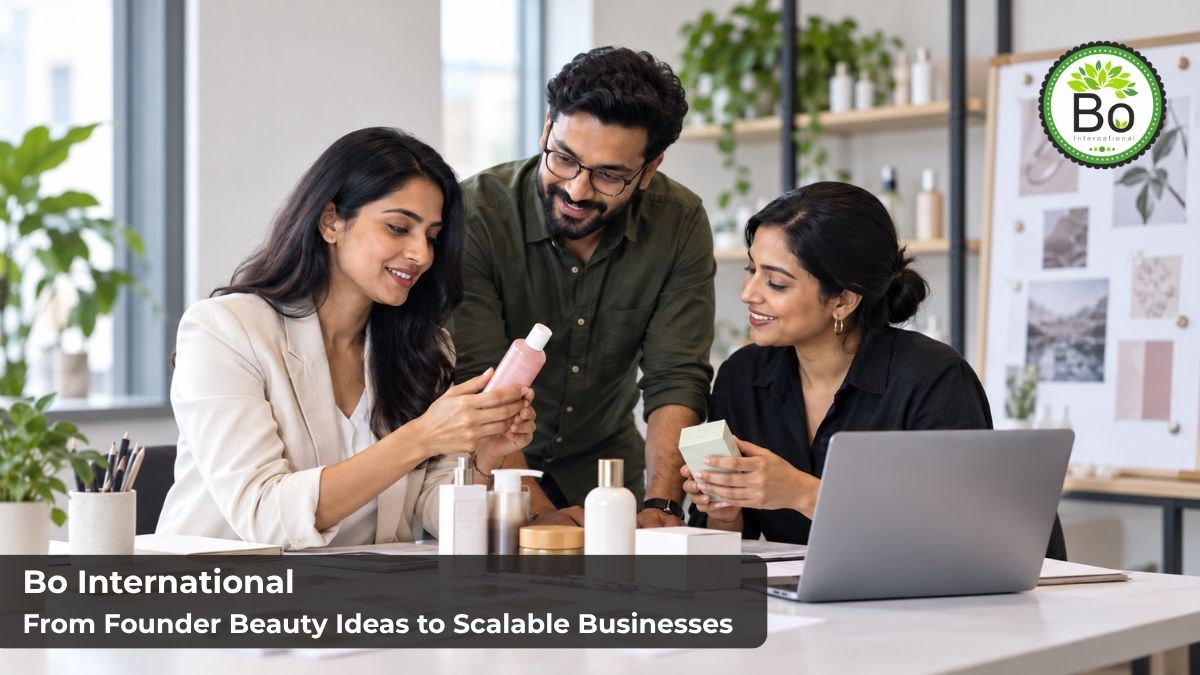
A product concept can sound convincing on paper. The first sample is where the concept becomes tangible. A founder can finally evaluate the texture, appearance, fragrance, usability, and overall product experience before committing to larger quantities. This stage can reveal practical issues early.
A serum may feel heavier than expected. A shampoo may need a different consistency. The packaging may not suit the formula as well as originally planned. Bo International’s process includes product sampling before production and packaging, giving brands an opportunity to assess the product before moving toward commercial manufacturing.
For startups, that checkpoint can also protect limited capital. Product changes are generally easier to manage before large volumes, packaging, and launch plans have already been committed.
Building More Than a Formula
A successful beauty product is rarely defined by formulation alone. The formula needs to work, but it also has to make sense within the larger brand.
Founders need to consider:
- the customer the product is being developed for;
- intended product positioning;
- texture and sensory experience;
- packaging format;
- expected selling price;
- product claims and differentiation;
- and how the first launch could eventually expand into a wider range.
Packaging is particularly important because it sits at the intersection of function and brand identity. The bottle, tube, jar, pump, or other format must work with the formula while also representing how the brand wants to appear in the market.
Bo International combines manufacturing with packaging and branding support, allowing these decisions to become part of the wider development process rather than separate steps.
Infrastructure Founders Do Not Need To Build Themselves
One of the biggest shifts in modern entrepreneurship is that businesses do not necessarily need to own every capability they depend on. A founder can build a beauty brand without first creating a laboratory, installing filling lines, hiring a large technical production team, or setting up an independent manufacturing facility. Instead, specialist manufacturing partners can provide that infrastructure.
Bo International operates from a 130,000-square-foot manufacturing facility and has a team of more than 250 people. The company says it currently works with more than 500 client companies and exports to over 50 countries. Its production infrastructure is designed to support bulk requirements, with the company stating capacity for thousands of bottles and tubes per day.
For founders, access to this type of infrastructure can allow internal attention to remain focused on areas such as:
- understanding customers;
- building the brand;
- creating distribution;
- developing marketing;
- establishing sales channels;
- and planning long-term growth.
The founder owns the business vision. The manufacturing partner supports the physical product behind it.
Leadership Behind The Manufacturing Model
Bo International is led by CEO Aayush Gupta, with the company positioning its model around end-to-end support for private-label and contract manufacturing clients. Its current services span formulas, raw materials, manufacturing, packaging, and related brand requirements.
That structure reflects a broader change in how product startups can be built. Instead of developing every operational capability internally, founders can work with specialized partners while concentrating their resources on the areas that create direct customer and business value.
For beauty entrepreneurs, this can reduce one of the major barriers between a product idea and commercial execution.
From The First Product To a Scalable Business
The first product is an important milestone, but founders building a long-term business usually need to think beyond the initial launch. A skincare brand may begin with one serum and later introduce cleansers, moisturizers, or related treatments. A haircare company might start with a shampoo and gradually expand into conditioners, oils, masks, or serums. A fragrance concept could eventually develop into a larger personal-care range.
Bo International’s manufacturing scope covers private label skincare, haircare, personal care, baby care, bath and shower products, perfumes, and other cosmetic categories. That breadth can become important when a startup begins expanding its portfolio.
But growth introduces new operational questions as well:
- Can production volumes increase without sacrificing consistency?
- Can packaging remain reliable across larger orders?
- Can the supply chain support repeat production?
- Can the same manufacturing relationship support the next product category?
These questions are part of scaling a product business. Manufacturing therefore becomes more than a launch requirement. It becomes part of the company’s long-term operating model.
The Business Behind The Brand
Consumers usually see the finished product. They see the logo, bottle, campaign, website, social media presence, and brand story. They rarely see what happens behind it.
Research, formulation, sampling, sourcing, testing, manufacturing, filling, packaging, and quality control all take place before the product reaches the shelf.
That behind-the-scenes layer is where companies such as Bo International operate. Its role is not to replace the founder’s idea or identity. It is to provide the manufacturing capabilities that can help transform that idea into something commercially viable. And that is what makes the model relevant to founders.
A beauty business does not necessarily have to begin with a factory. It can begin with a customer problem, a product idea, and a founder who believes there is an opportunity worth pursuing. With the right product strategy and manufacturing support behind it, that idea can move from concept to launch—and from its first production run toward a scalable business.